Structure without canvas or padding
A tailored jacket keeps its chest through internal cloth and pad work. That structure gives a clean shoulder, but it traps body heat when a room fills up. Our two piece dashiki set drops the shoulder pads and the chest canvas entirely. The shirt hangs from the natural shoulder line. Air moves freely behind the front placket because there is no lining between the cloth and your skin. You get coverage without the weight of an interlining. The long sleeves end cleanly at the wrist, giving the visual weight of formal dressing while leaving the body unencumbered by heavy layers.
Matching prints cut as one
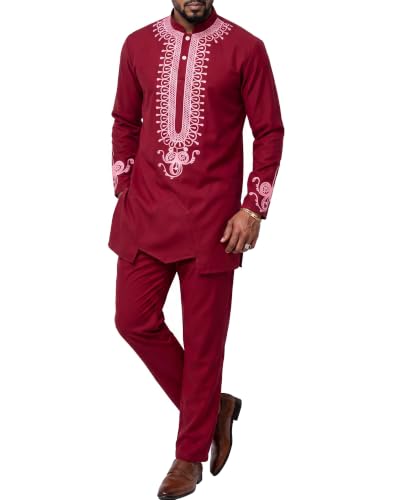
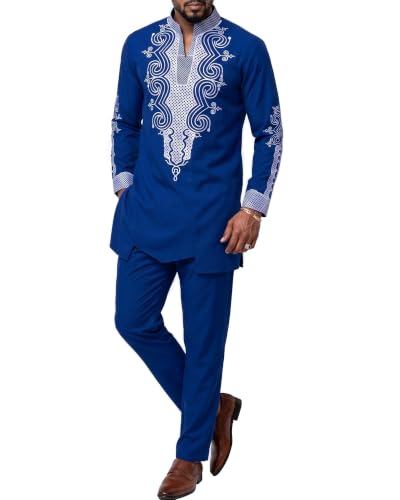
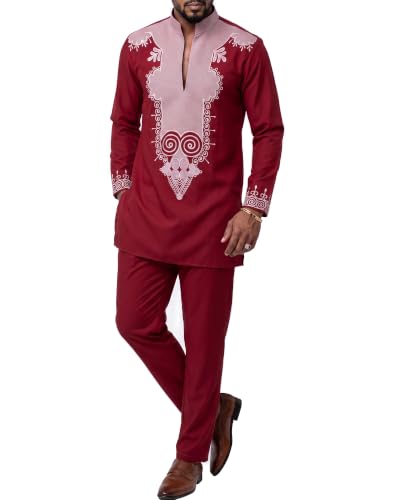
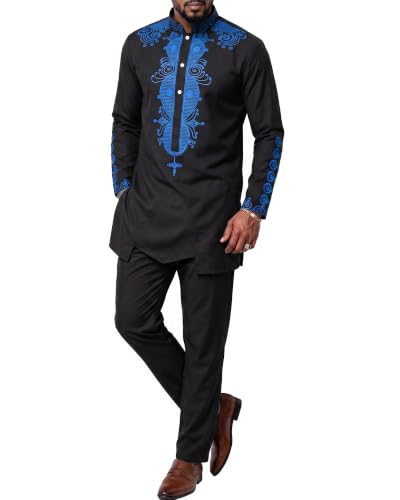
Printed tops bought on their own rarely match separate trousers. One print runs larger, or the motif turns at an awkward angle between the two garments. We cut 11 two piece dashiki sets where the shirt and trousers share the exact same pattern scale. The design moves continuously down the front of the top and repeats down the leg. When both pieces arrive together, the pattern alignment works as intended. Trying to combine separate prints usually produces a break at the waist that distracts the eye. A paired set avoids that problem before you put it on.
Room through the chest and leg
Tailoring sits close to the ribs and tapers toward the hip. A dashiki set is cut loose through the torso. The shirt does not pull across the back when you reach forward or sit down. Below the waist, the matching trousers follow that same ease with room through the seat and thigh. This is not casual sizing; it is how the garment breathes. The looser drape prevents the printed cloth from catching or pulling across tension points. It stays smooth over the body without clinging, letting the cloth move as you walk rather than binding at the joints.
Care without flat pressing
A stiff dress shirt needs sharp crease lines ironed flat into the cloth. Pressing a dashiki shirt with a heavy hot iron crushes the texture and leaves hard lines down the chest where the pattern should sit softly. Hang the shirt on a shaped hanger after washing and let gravity take out the heavy wrinkles. If the cloth holds fold marks, use a steam pass rather than a direct iron plate. The trousers hang by the hem on a clamp hanger. Gentle steam relaxes the fibers while keeping the natural shape of the open weave.
Wearing the set in heat
Warm events indoors challenge standard tailored coats. A three piece suit or a lined tuxedo coat holds warm air against the ribs for hours. The dashiki set handles high room heat by remaining open around the neck and body. There is no lapel to fold back and no waistcoat sitting over the shirt front. You remain fully covered for an evening event while wearing a single layer of cloth. The set functions as complete formal wear without requiring you to carry a jacket over your arm when the hall gets crowded.
Choosing the unpadded set
When a warm venue makes a lined jacket uncomfortable, the two piece dashiki set provides full coverage with zero canvas weight. The shirt and trousers arrive together with matching prints ready to wear. Hang the pieces to let steam clear the folds, and wear them loose for natural airflow.